The question bank.
It tells you what you got wrong. Between the missed question and the 40-page chapter, there's nothing to go back to.
For medic students who know the material

Paramedic study notes, whittled down to the batting order. One topic per page: what it is, why it happens, what comes first, and what waits. Built on the exam in use since July 1, 2024.
Every topic, the same three lines:
7-day money-back guarantee. If it isn't helping, email us and we refund you in full. No forms.
One payment, no subscription · Instant PDF download
“All the answers seemed correct”
“it was like all the answers seemed correct.”
You did well in class. You ran the practice questions until the scores looked fine. Then the exam put four answers in front of you, all of them things you would do, and asked which one comes first.
We read 1,217 posts from people who had failed the NREMT. One in three said they had done well in school. More than one in three were already using a question app. They didn't write “I didn't know cardiology.” They wrote this: “it was like all the answers seemed correct.”
That isn't a knowledge gap. It's an order gap. School and apps train you to recognize facts: signs, drug lists, acronyms. The exam asks you to put them in order with only what the question gives you. We call the first one the list. A list has no order. A batting order does: it tells you who's up first, who's next, and who waits. Every page of these notes is built that way.
It tells you what you got wrong. Between the missed question and the 40-page chapter, there's nothing to go back to.
Fine for a second read, until it skips operations or buries the one line you needed in a wall of text.
One chapter per body system, for an exam that is more than a third clinical judgment.
What helps is a page that already knows the order. That's how these notes are written.
The Batting-Order format
Whittled down to what you need, in the order you need it. After the second page you know exactly where to look.

And under it, the answer that tempts you, with its verdict:
The decision comes last on purpose. A first move without the why is one more thing to memorize. After the why, it's the only answer that makes sense.
The part nobody teaches
The notes open with the exam itself, from the National Registry's own published documents:

Chapters follow the subjects you know from class, because that's how you name your weak areas. On top of every chapter sits its exam domain and weight.

| Exam domain (in use since July 1, 2024) | Weight | Where it lives in the notes |
|---|---|---|
| Clinical Judgment | 34 to 38% | The “What comes first” line on every page, plus 24 worked calls |
| Medical, Obstetrics and Gynecology | 24 to 28% | Medical, Pharmacology, OB and Neonatal, Peds and Geriatrics |
| Cardiology and Resuscitation | 10 to 14% | Cardiology: one rhythm per page, 12-lead, arrest |
| Airway, Respiration and Ventilation | 8 to 12% | Airway |
| EMS Operations | 8 to 12% | Operations |
| Trauma | 6 to 10% | Trauma |
Domains and weights from the National Registry Paramedic test plan.
These are the actual pages, not a mockup.
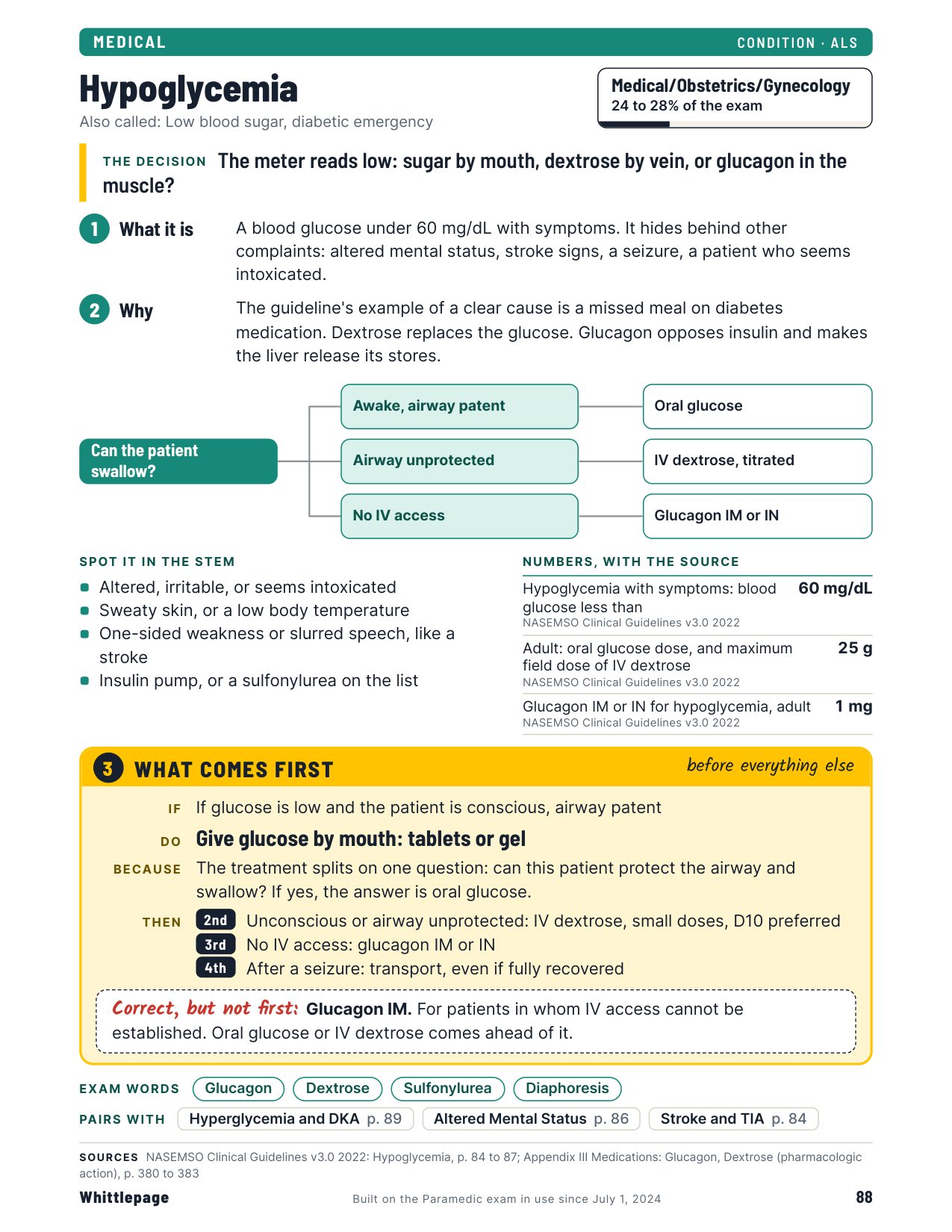
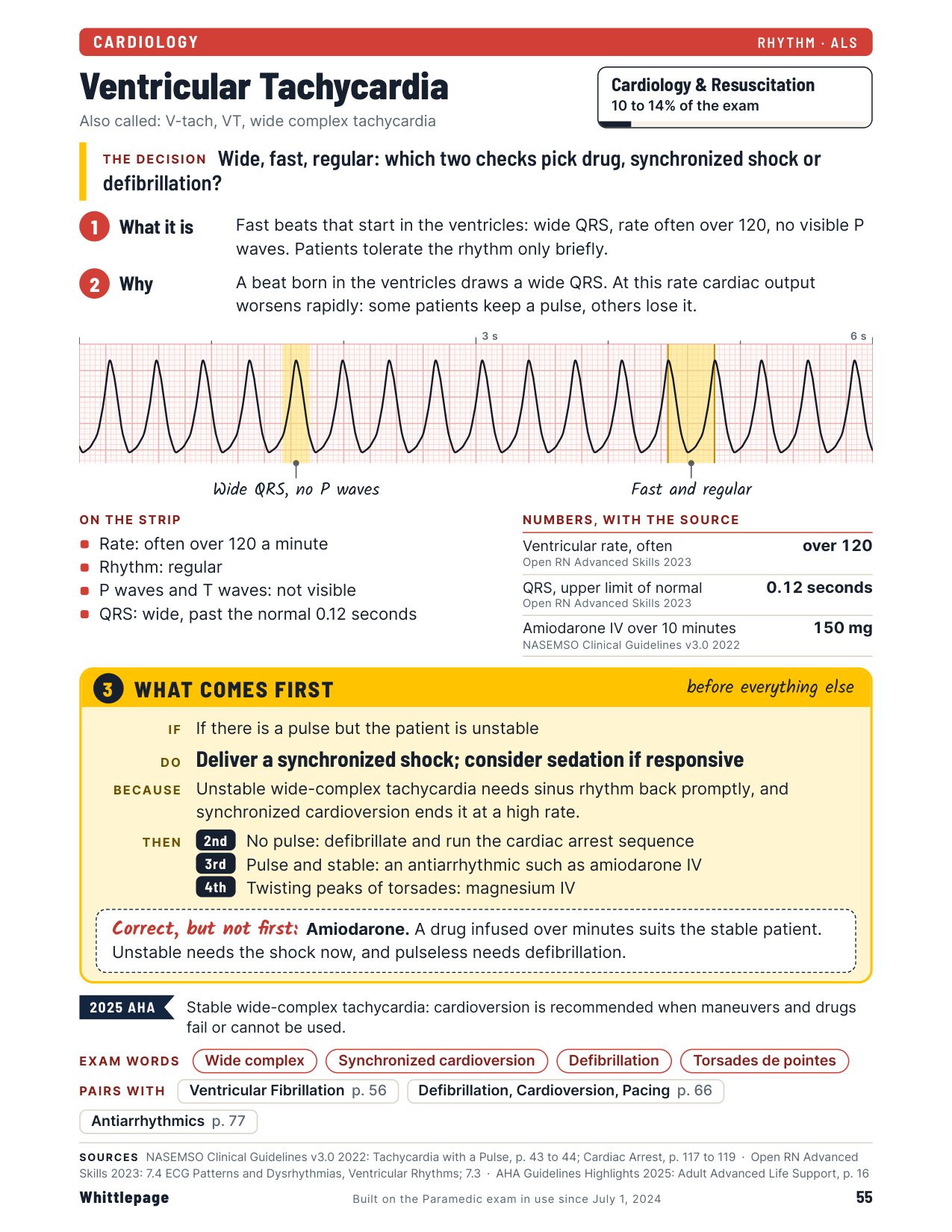
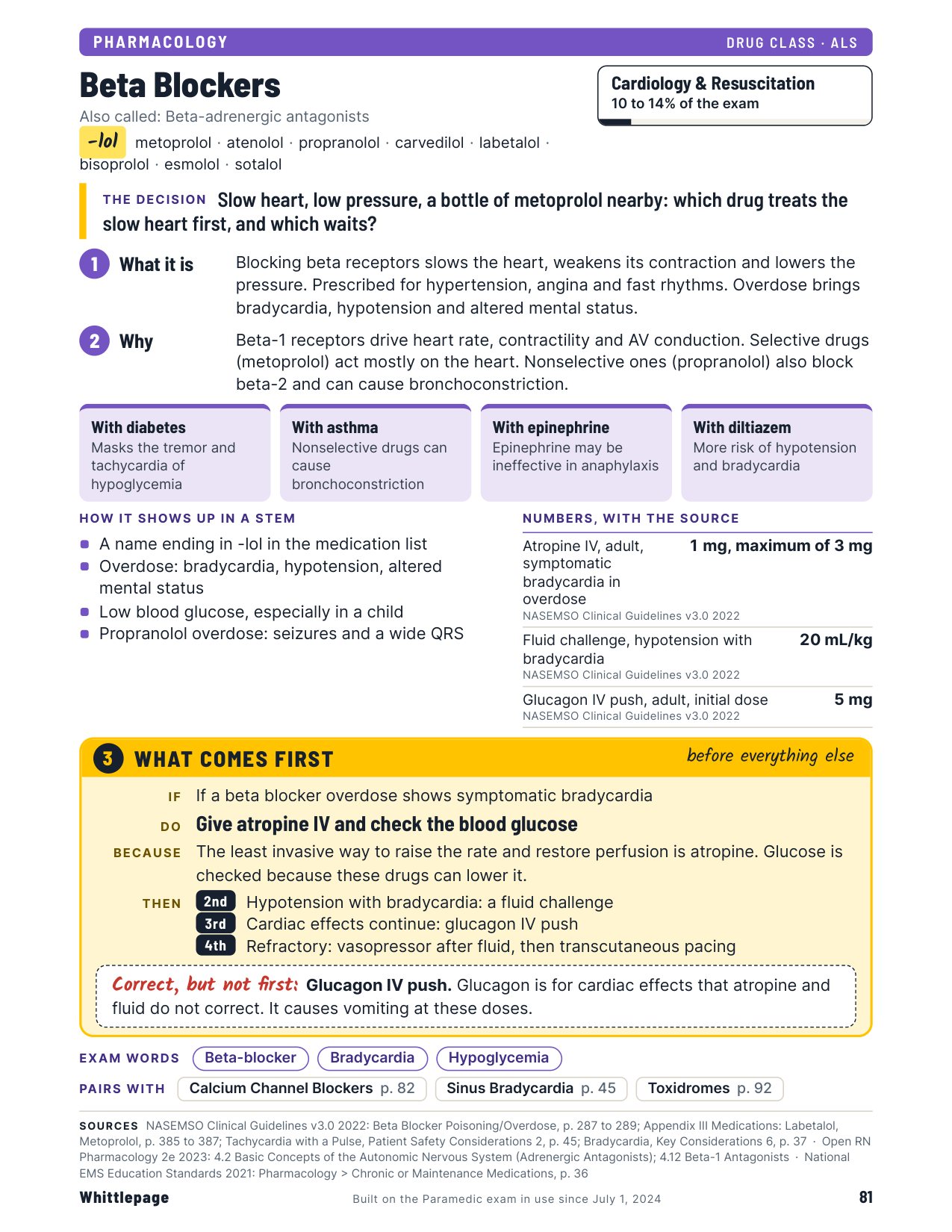
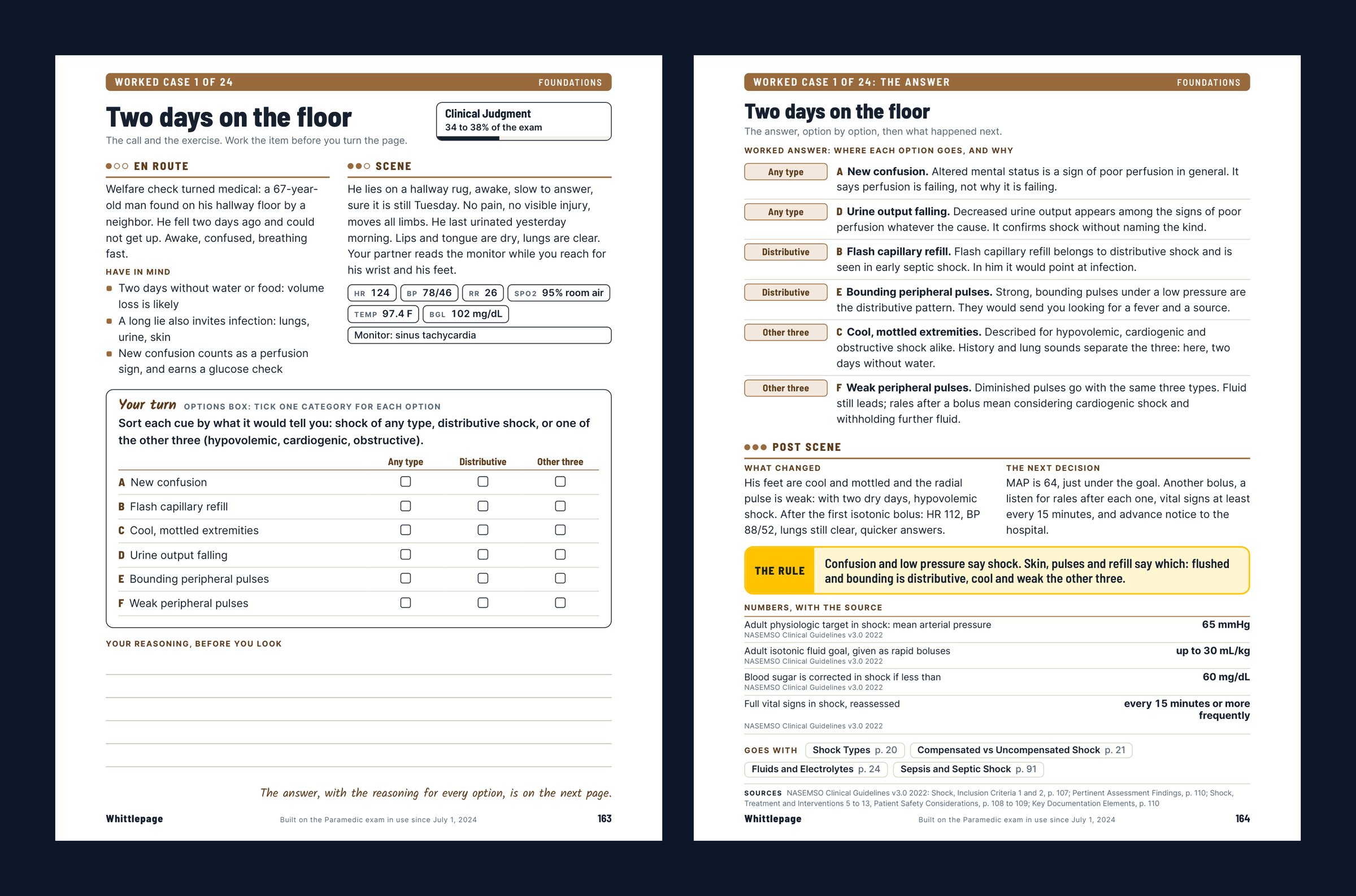
Swipe for more · tap a page to open it full sizeScroll sideways for more · click a page to open it full size
What's inside
Plus 24 worked calls in three phases (en route, on scene, after), with the reasoning for every option, and a glossary of the words that questions use.

Every practice question you miss goes on one line and points to its page. In a week you can see your weak areas instead of guessing them.

Didn't make it last time? The score report gives you one number and no list of weak spots. The plan starts from that number and from your Miss Log, and works the days before your next attempt, weakest subject first.

A print edition that goes easy on ink, a tablet edition with a clickable index you can write on, and a phone edition with one column and large text.
Read The Exam, Decoded once. It takes about half an hour.
Open the chapter, one topic per page, and read down to the first move.
Missed a practice question? Log it, read the page, move on.

Total value$77
Today$49
7-day money-back guarantee. If it isn't helping, email us and we refund you in full. No forms.
One payment. No subscription, nothing to cancel. Secure checkout by Stripe. Refund policy.
Wrong answers are the first thing students complain about in paid study material. So every page here carries its sources at the bottom, and every number on the page (a dose, a rate, a threshold) is listed with the document and the section it was taken from.
The core sources are the ones the exam is built on: the National Registry test plan, the National EMS Education Standards, the National EMS Scope of Practice Model, the national model clinical guidelines, and the 2025 AHA guidelines for CPR and emergency cardiovascular care. Open medical texts fill in the physiology and the rhythm recognition. 53 sources in all, listed at the back.
Read The Exam, Decoded and three topics you're weak on. If it isn't helping, email [email protected] within 7 days of your purchase and we'll refund you in full. No forms.
Questions
For the sections where you're weak, yes. These notes are the second read: the whole course on one topic per page, for the weeks before the exam. They don't replace your program.
There are, and some are good. What's hard to get for free is knowing where each line comes from, a page built on the exam in use today, and the first move spelled out for every topic.
Whittlepage is an independent publisher. We are not a medic school and we are not the National Registry. We built these notes from the documents the exam is built on, and every page shows its sources so you can check any line.
Keep the app. It tells you what you missed. These notes are the page you go back to, and the Miss Log ties the two together.
It's built on the Paramedic exam in use since July 1, 2024, with its six domains. Pages touched by the 2025 AHA guidelines are marked.
No. It isn't a question bank or a simulator. You get worked calls with the reasoning for every option, and the newer question types explained with our own examples.
No. One payment, no trial, nothing to cancel.
It's a PDF, nothing ships. You get a print edition for US Letter paper, a tablet edition with a clickable index, and a phone edition. Download links arrive on the page after payment and by email.
Email us within 7 days and we refund you in full. Full policy on the refund page.
This edition is built for the Paramedic exam. The EMT exam has different domains and a different scope, and it gets its own edition.
No. Whittlepage is independently developed and is not affiliated with or endorsed by the National Registry of Emergency Medical Technicians or the American Heart Association.
No. It's study material for a national exam. It follows the national standard the exam tests, and it doesn't replace your program, your local protocols or your medical director.
Spend the days you have on what comes first.
7-day money-back guarantee. If it isn't helping, email us and we refund you in full. No forms.
Before you pay
Tick what you want, then continue to payment. One checkout, one email, everything in it.
7-day money-back guarantee. If it isn't helping, email us and we refund you in full. No forms.
Secure checkout by Stripe. Instant download. One payment, nothing to cancel.